Foundational Stage: Toddlers, LN, UN, KG
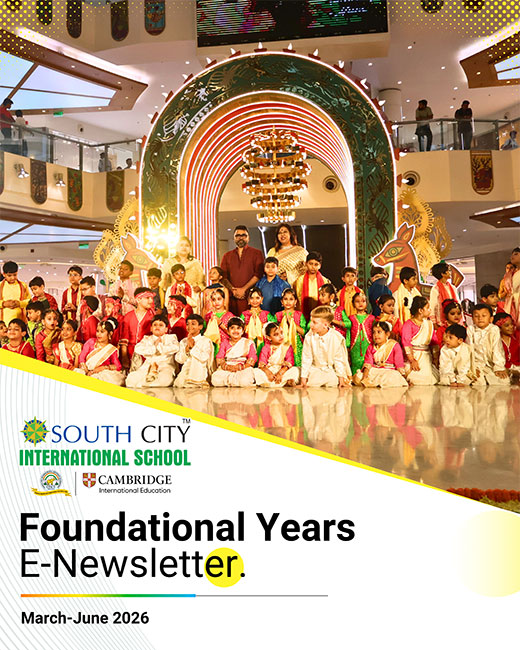
Our Pre-Primary Programme focuses on nurturing young learners through a joyful, safe, and stimulating environment that supports their emotional, social, physical, and early cognitive development.
Pedagogy
- Play-based and experiential learning
- Hands-on activities, storytelling, rhymes, and role play
- Nature-based learning and celebration of festivals and cultural events
- Learning through exploration, imagination, and discovery
- Strong parent partnership and regular interaction
Core Areas
Early Literacy (pre-reading and pre-writing skills), Early Numeracy (number readiness and basic concepts), Environmental Awareness, Language Development (English & Hindi/Bengali), Motor Skills Development (fine and gross motor)
Co-Curricular: Music & Movement, Art & Craft, Dance, Free Play & Structured Play, Storytelling & Puppet Shows
Key Highlights
- Focus on social skills, communication, and confidence building
- Circle Time for bonding, expression, and emotional development
- Theme-based learning approach
- Safe, caring, and engaging classroom environment
Assessment
- Observation-based assessment
- Portfolio and activity-based evaluation
- Continuous and informal feedback on developmental milestones
Classes I-II
Our Foundational Years programme for Class I & II focuses on holistic development, building a strong academic foundation while nurturing social, emotional, and creative growth.
Pedagogy
- Experiential and activity-based learning
- Hands-on activities, storytelling, and field trips
- Nature-based learning and cultural celebrations
- Strong parent partnership
Core Subjects: English, Mathematics, Environmental Science, Hindi/Bengali, Foreign Language (French/Mandarin), Computer Science, General Knowledge, Moral Science
Co-Curricular: Music & Dance, Sports, Art, Robotics, Library, Storytelling, Cubs & Bulbuls
Academic Enrichment Programs: Student-led conferences for confidence building, Olympiad, Spelling Bee, LogiQids, Mindspark, YLE
Key Highlights
- Focus on fitness, communication, and overall development
- Circle Time for bonding and confidence building
- Balanced academics and activities
Assessment
- Graded worksheet system
- Continuous assessment with short, structured tests
Preparatory Stage: III-V
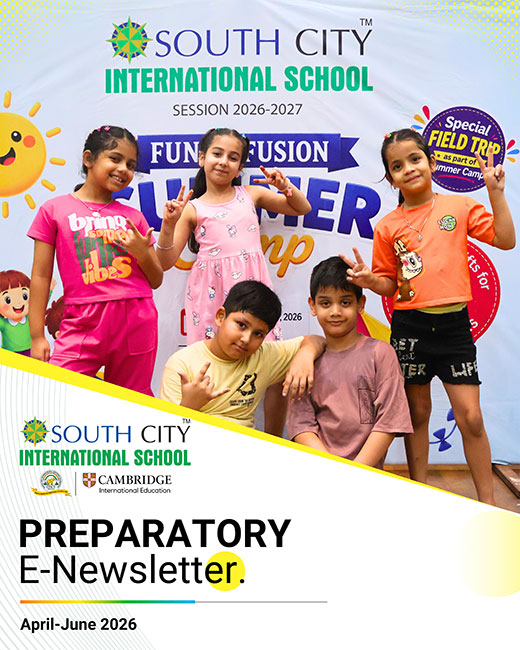
For students in Grades III, IV, and V, our approach focuses on strengthening foundational concepts while gradually fostering independence in learning. At this stage, emphasis is placed on developing critical thinking skills, encouraging curiosity, and promoting exploration across subjects. Through engaging and interactive learning experiences, students are guided to ask questions, solve problems, and build confidence as independent learners.
Our Pedagogy
- Interdisciplinary Projects: Encouraging real-world problem-solving, collaboration, and communication.
- Flipped Classroom Model: Promoting active learning, discussions, and in-depth understanding.
- Peer Teaching: Reinforcing understanding and communication skills.
- Research Skills: Teaching students to find credible sources, analyze information, and present findings.
- Inclusivity: Incorporating diverse perspectives and experiences.
- Experiential Learning: Utilizing field trips, nature exploration, and hands-on experiences.
- Service Projects: Fostering empathy, teamwork, and civic responsibility.
- Book Reading Sessions: Instilling a love for reading.
- Critical Thinking: Developing argumentation skills through debates and persuasive writing and Elocutions.
Subjects Offered
- English
- Mathematics
- Science
- Social Studies
- French/Mandarin as a foreign language
- Hindi/Bengali as a second language
- Computer Science
- General Knowledge
- Life Skills
Co-Curricular Subjects
- Music and Dance
- Library
- Art
- Cubs and Bulbuls
- Sports
- Read Programme
- Robotics
- Mindspark
- Experiential learning through field trips, projects, and presentations.
Sports
- Emphasizing the comprehensive growth of children, our sports curriculum is designed to enhance their skills while giving paramount importance to strength, flexibility, and the mastery of body balance techniques.
Our Assessment Approach
- Assessment for Learning: Using observations, discussions, and project evaluations.
- Formatted Tests: Conducted through Friday Tests, Unit Tests, and Term End Examinations to promote knowledge, understanding, and application skills.
Distinctive Features
- Graded Worksheet System: Tailored for all learning abilities.
- Open Book Examinations: Evaluating critical thinking over rote learning.
- Language Choices: Offering French and Mandarin to explore international culture.
Middle School: VI-VIII
Our academic programme is aligned with the National Education Policy (NEP) 2020, fostering conceptual clarity, interdisciplinary learning, and holistic development.
Pedagogical Approach
- Focus on abstract, analytical, and critical thinking skills
- Integrated and cross-curricular learning experiences
- Project-based and experiential learning methodologies
- Emphasis on cultural heritage and linguistic diversity
- Development of vocational awareness and practical skills
- Value-based education promoting ethics and character
- Engagement with Indian classical literature
- Health, well-being, and life skills education
- Awareness programmes on responsible decision-making
Core Subjects
- English Language & Literature
- Mathematics
- Science (Physics, Chemistry, Biology)
- History & Civics
- Geography
- Computer Studies
Languages
- Second Language: Hindi, Bengali, French
- Third Language: Hindi, Bengali, Sanskrit, French, Mandarin
Co-Curricular Programme
- Performing Arts
- Visual Arts
- Physical Education
- Current Affairs
- Life Skills Education/ Logical Reasoning Classes
- READ Programme
Distinctive Features
- Flexible third language options, including Mandarin
- Participation in Olympiads/ Spellathon, LogiQids to enhance analytical skills
- Exposure to AI, Robotics, and Karate training
- Opportunities in Indian & Western Music and Dance
- Academic support for OBE/NIOS learners
- Experiential learning through field trips and projects
- Student-led Interdisciplinary group presentations and collaborative learning
- Active participation in cultural, literary, and sports events
- Structured community service initiatives
- Open Door assessments in Mathematics and Science to gauge conceptual understanding.
- Choice of 16 diverse clubs, enabling students to explore interests and develop skills beyond the classroom
- A dynamic sports curriculum provides students with diverse opportunities to explore and excel in different disciplines.
Examination Pattern (Classes VI-VIII)
At South City International School, student progress is assessed through a balanced and continuous evaluation system.
Academic Structure
- Two Terms: Term I & Term II
-
Each term includes:
- 4 Formative Assessments
- 1 Summative Assessment
Formative Assessments
- Weekly Friday Tests
- Unit Tests
- Notebook Submissions
- Classroom Observations / Projects
Summative Assessment
Secondary (Classes IX & X)
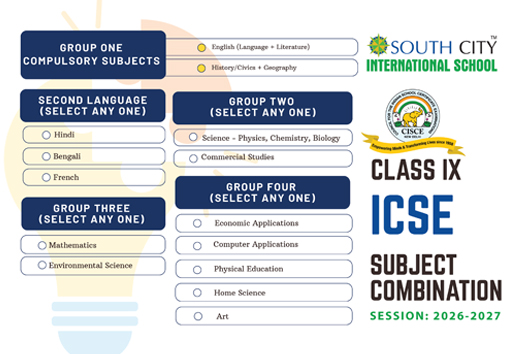
At South City International School, the Secondary Programme (Classes IX–X) follows the I.C.S.E. curriculum and offers a holistic, interdisciplinary approach to education. The focus is on building strong conceptual foundations, encouraging practical application, and developing critical thinking and problem-solving skills, while nurturing well-rounded individuals.
Subjects Offered
Programme Highlights
-
Flexible Curriculum Pathways
Students are offered the flexibility to tailor their academic journey with options between Science and Commercial Studies, along with the choice of Mathematics or Environmental Science (EVS).
-
Global Perspective
A forward-looking curriculum enriched with opportunities to learn international languages such as French, fostering global awareness and cultural appreciation.
-
Holistic Development
A balanced integration of academics, arts, and sports to nurture physical well-being, creative expression, and intellectual growth.
-
Innovative Teaching Practices
Dynamic, interactive, and collaborative classroom environments that encourage creativity, critical thinking, and experiential learning.
-
Co-Curricular Engagement
A wide range of clubs and activities designed to cultivate diverse talents, interests, and leadership skills.
-
Values and Awareness
A strong emphasis on environmental responsibility, ethical values, and an inclusive, gender-sensitive learning environment.
-
Experiential Learning
Learning beyond the classroom through field trips, projects, and meaningful community service initiatives.
Examination Pattern
At South City International School, student progress is assessed through a balanced and continuous evaluation system.
Academic Structure
- Two terms: Term I and Term II
-
Each term includes:
- 4 Formative Assessments
- 1 Summative Assessment
Formative Assessments
- Weekly Friday Tests
- Unit Tests
- Notebook Submission
- Classroom Observation / Projects
Summative Assessment
Senior Secondary Programme (Classes XI–XII)
Introduction
Our Senior Secondary Programme is aligned with the National Education Policy 2020 and CISCE (ISC) guidelines, offering a balanced, future-focused curriculum that encourages interdisciplinary learning, critical thinking, and academic excellence.
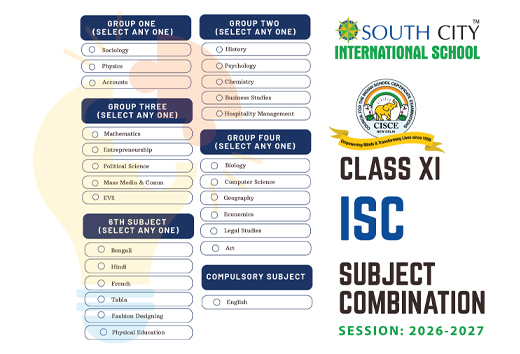
Subjects Offered
A wide range of subjects across Science, Commerce, and Humanities streams is offered.
Students have the flexibility to choose interdisciplinary combinations based on their interests and career aspirations.
Pedagogy
Our approach integrates conceptual clarity with application-based learning through interactive classrooms, project work, and experiential methods. Emphasis is placed on analytical thinking, research skills, and real-world relevance.
Distinctive Features
- Flexible subject combinations
- Career counselling and university guidance
- Internship opportunities across sectors
- Exposure to global exchange programmes
- Focus on holistic development and student well-being
Evaluation
The academic year is divided into two terms, with continuous assessment through:
- Formative Assessments: Weekly tests, unit tests, projects, and classwork
-
Summative Assessments: End-of-term examinations
A variety of assessment formats, including open-book and application-based tests, ensure deeper understanding and consistent progress.
 375, Prince Anwar Shah Road, Kolkata, West Bengal, India
 033 4007 2000
 info@scis.co.in